Luke 7:11-16
Glory to God the Father, the Son, and the Holy Spirit.
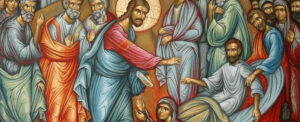
This morning the Lord Jesus Christ raises up from the dead the only son of a widow.
The miracles of Christ are signposts pointing out that the Kingdom of Heaven, the presence of God, has broken in among the kingdoms of the earth.
So today a widow is without the financial support and protection of a husband. Now, with the death of her only son she is deprived of any financial support and protection. She has nobody at all. There’s no safety net. There is no insurance. She faces starvation or exploitation.
The Lord sees this woman, whom he made in his own image; he has compassion on her and restores her son to her, so that she receives what she needs. To her son he restores the life he was meant for, and the Kingdom of Heaven is manifest on earth.
In scripture, Solomon says, “God did not make death, and he does not delight in the death of the living. For he created all things that they might exist, and the generations of the world so they might be preserved… for righteousness does not die” (Wisdom 1:13-15).
Here is how the Kingdom of Heaven is manifest here this morning. God the Word, who is the Way, the Truth and the Life, calls this young man back from death to life. And we read that “great fear came upon all.” Why fear? Because this is something only God can do, and here he is among them as a Man. They exclaim, “God has visited His people!”
God has visited His people. Okay, now what? The curse of death has been undone right before our eyes! Okay, now what?
Well, after church today, we’ll have some lunch, maybe a nap, and probably spend a little time scrolling Facebook or watching the TV. Then back to work or school on Monday, where we will forget that we ever had an encounter with the living God.
Does that sound cynical? Why even bring it up? Because it is possible to witness the resurrection power of Christ our God and to do nothing about it. To be unchanged by it.
The Kingdom of Heaven is manifest to you, precisely so that you may repent, so you might change the direction of your life, so you might stop existing in the same sad status quo, so that you might live up to your purpose.
So in a few minutes we’ll sing, “Let us who mystically represent the cherubim, and sing the thrice-holy hymn to the life-creating Trinity, now lay aside all earthly cares that we may receive the King of All, who comes invisibly upborne by the angelic hosts.”
And then we will receive into our own bodies the living, resurrected, deified body of Christ our God, for the remission of our sins and unto life everlasting. His living, life-giving blood in your veins; the resurrected body of the living God in your bones and muscles. Bringing the healing and power and purity of almighty God inside you.
The Kingdom of Heaven is come for you today. The Lord wants to get your attention. Do not settle for life as usual. Don’t settle for what you are now.
“If anyone is in Christ, he is a new creation; old things have passed away; behold, all things are made new” (2 Corinthians 5:17).
We already know from experience that settling for the familiar is the way of regret. And yet, we stay where we are.
Not one of us gathered here today wants to experience change. We want to be different, but we hate change. Change is hard. That’s normal. But if we’re going to live in the Kingdom of Heaven, in this life and in the life to come, then change is coming. All things are made new.
Every change is a little death. What we were ends, and someone a little different carries on. “Now if we have already died with Christ, we believe that we shall also live with Him… It is no longer I who live, but Christ lives in me; and the life which I now live in the flesh I live by faith in the Son of God, who loved me and gave Himself for me…” (Romans 6:8; Galatians 2:20).
Today’s Gospel reading is about a death and a resurrection. To the people who saw it, it was like lightning had just struck! “Then fear came upon them all, and they glorified God, saying, ‘A great prophet has risen up among us!’ and, ‘God has visited His people!’”
And to us, looking back through the lens of the Cross and the Lord’s Resurrection, looking forward to the day of the Lord, it’s a signpost pointing straight toward the resurrection of all the dead and the life of the age to come.
In American culture, we are taught that you’re going to live seventy, eighty years and then you will die and go to heaven – or to the Bad Place.
The whole “go to heaven” business of halos and clouds and harps and little wings is not a very compelling or even interesting thing to look forward to. But “I look for the resurrection of the dead and the life of the age to come.”
* * *
Somebody asked me this week: Why did Christ die? Why the cross? Can’t God just forgive sins?
Of course, God can forgive sins just because you asked, and because it’s what he delights to do! And nobody can stop him.
And the Lord has gone up onto the cross, because that was his plan, to enter into death and plunder hell, and lead out all the prisoners from ages past into Paradise. He has freely accepted the cross, the tomb, the glorious resurrection, and now sits at the right hand of God the Father, and now the kingdom of heaven is in your midst.
Well now what? What do you plan to do about that? I’ll tell you what the Lord has planned for you. Over and over in the New Testament, the apostles call you: saints.
“To all that be in Rome, beloved of God, called to be saints: Grace to you and peace from God our Father, and the Lord Jesus Christ” (Romans 1:7).
“To the church of God which is at Corinth, to them that are sanctified in Christ Jesus, called to be saints” (1 Corinthians 1:2).
That last one is interesting because if you actually read Saint Paul’s first letter to the Corinthians, that was possibly the most dysfunctional church in the whole Christian world at that time. There were schisms, there was sexual immorality and they were proud of their tolerance, there was every kind of disorder and error and bad judgment. So how does Paul begin his letter to them? “To those who are set apart for holiness in Christ Jesus, called to be saints.”
Only after he has named the Corinthian Christians for what they are – men and women of God, called and appointed to eternal life in the risen Christ and set apart for union with God in the age to come – only then does he begin to correct and tell them what we can and cannot do as citizens of that kingdom of heaven, how to treat wives and apostles and the Eucharist and their own bodies. And he ends with teaching on the resurrection of the dead and the life of the age to come.
C.S. Lewis said, “We are half-hearted creatures, fooling about with drink and sex and ambition when infinite joy is offered us, like an ignorant child who wants to go on making mud pies in a slum because he cannot imagine what is meant by the offer of a holiday at the sea. We are far too easily pleased.”
There used to be a saying, “You only live once!” And some folks took that and ran with it into indulgence — and others, it led to preparation for what comes after.
“You only live once,” and “life is short.” But it’s not that life is too short — It’s that eternity is so long.
If you talk to a child in kindergarten – she’s learning her colors, learning how to paste – and you tell her this is not what she is destined for; she’s going to be an architect, a business owner, a wise parent and spiritual mother… that’s way outside what this little one can comprehend.
“But you are a chosen generation, a royal priesthood, a holy nation, a people belonging to God, that you may proclaim the praises of Him who called you out of darkness into His marvelous light” (1 Peter 2:9).
“Know ye not that the saints will judge the world? Do you not know that we shall judge angels?” (1 Corinthians 6:2-3).
“He has made us kings and priests unto our God: and we shall reign on the earth” (Revelation 1:6; 5:10).
I don’t lie awake in terror that a cruel God will sentence me to hell because I failed to live up to his rules. We don’t fear the Lord as if we’re terrified of an abuser. When we start to know what God is calling and bringing us to become, then what we fear is the very real danger that here and now the things we love will build us a life apart from him, alone in outer darkness, by our own choices right now.
We end so many of the prayers in the Liturgy by saying “for God is good and loves mankind.” And I have said many times that we don’t live like people who really believe that. What would our life look like if we really believed that the God who is good loves us, and will do everything it takes to bring us to the likeness of Christ in the kingdom of God. He’s bound himself with a covenant to bring it to pass.
Well, there’s another thing we say all the time but I don’t think we mean it: “I believe, O Lord, and I confess that thou art the Christ, the Son of the living God, who didst come into the world to save sinners, of whom I am first.”
We confess, “I am the worst of sinners.” And many times that is just language, it’s just something we say. Until we start to be confronted with the disorder in us, the passions and self-will that have been running our lives and still own so much of our behavior. It’s not any one here I’m talking about; this is a factor in confession and struggle for most of us: We are shocked by the depth of the sins we see in ourselves, and we wonder if we are even Christians. Do I even love the Lord? Can I even say that I want to be saved form these sins, when I go back to them daily?
In the Desert Fathers, “a brother asked an elder: How is it that some people see revelations and visions of angels? and the elder said: Blessed is he who sees his sins all the time because such a man is always alert.”
And Saint Anthony the Great said, “This is the great work of man: always to reproach himself for his own faults before God, and expect temptation until the last breath.”
The Lord demonstrates his faithfulness and goodness to us by revealing to us the sins that we have left unquestioned for so long. He lets us start to see how wrong our hearts are, shows us the sins that are hurting us and the people around us, because these are what he plans to heal in us, with our cooperation.
You know, there is a kind of confession that is genuinely contrite over sins — not because we feel pain over our disloyalty and lack of love for Christ our God, but because we are frustrated and know we could have avoided these acts or words. We are really confessing, “This was unacceptable, because I know I am better than this!” Our confession is coming from our wounded ego. It’s an exercise in pride.
And God may be choosing at this time not to deliver us from our besetting sins precisely because this painful, repeated experience has not yet humbled us enough so we will stop believing we are not that bad.
Saint Isaac said, “Do not fall into despair because of stumblings. I do not mean that you should not feel contrition for them, but that you should not think them incurable. For it is more expedient to be bruised than dead.”
And Saint Joseph the Hesychast: “Every time you fall, get up again and at once seek forgiveness. Don’t hide sorrow in your heart, because sorrow and despondency are the joy of the evil one. They fill one’s soul with bitterness and give birth to many evils. Whereas the frame of mind of someone who repents says, ‘I have sinned! Forgive me Father!’ and in this way confidence expels the sorrow. He says, ‘Am I not a weak human? So what do I expect?’ Truly, my child this is how it is. So take courage.”
Today the Lord raises the son of the widow from the dead, as a sign of the coming resurrection. In the gospels, we see the Lord headed toward his own glorious resurrection and ascension, and sitting at the right hand of the father. But for Christ, the road to the resurrection is the way of the cross.
And it won’t be otherwise for us who walk with him.
We live in a culture that sees struggle as something terrible and unnatural. “I’m struggling with this” means “I am getting beat up and it’s causing me pain and stress. Make it end!”
In fact it’s possible to become convinced that all our stress and pain are temporary, and when they pass we will return to a state of peace and contentment — then we’ll finally be able to relax, when things return to normal. But the fact is that most of us are in a state of stress or crisis, fear or grief, or inner conflict that at times feels like it might break us. It’s been said that “Peace is the ideal we infer from the fact that there have been occasional lulls between wars.”
During my time at the monastery, I realized I had landed in a very different culture when I noticed that struggle was assumed to be normal, healthy and good. I’d hear them say, “How are you doing?”
“I’m struggling.”
“Good!”
To the monks, the other alternative — not struggling — implied drifting passively downstream to destruction. Only by being intentional can a person awaken from sleepwalking, struggle against his habits and patterns of thought, deny himself, take up his cross and follow Christ.
Saint Philaret said, “A fish that is alive swims against the flow of water. One that is dead floats down with the water. A true Christian goes against the current of a sinful age. A false one is swept away by its swiftness.”
Our confidence and assurance is not in our faithfulness, our record of obedience and disobedience; it is in the faithfulness of Jesus Christ who has said “Never will I leave you, never forsake you” (Hebrews 13:5).
Imagine a child who has never been told he is bad. Who has gone running to his dad with a skinned knee and his dad said “I’m glad you brought this to me; let’s make it better.” Who went to his father and admitted he had done something shameful, and his father said “I’m glad you brought this to me; let’s make it better.” What confidence that young person would have, growing into adulthood and into an adult’s struggles, knowing that he has a father who’s got his back. If that’s not your father, then now you’ve received a new one, who has dedicated himself to showing you what a good and dependable Father is.
“Do not cast away your confidence, which has great reward. For you have need of endurance, so that after you have done the will of God, you may receive the promise… Therefore, since we are surrounded by so great a cloud of witnesses, let us also lay aside every encumbrance, and sin which so easily entangles us, and let us run with endurance the race that is set before us, fixing our eyes on Jesus, the Author and Perfecter of our faith” (Heb 10:35-36;12:1-2)
To the glory of God the Father, the Son and the Holy Spirit. Amen.