By thy Nativity, O Most Pure Virgin, Joachim and Anna are freed from barrenness; Adam and Eve, from the corruption of death. And we, thy people, freed from the guilt of sin, celebrate and sing to thee: The barren woman gives birth to the Theotokos, the nourisher of our life.
— Kontakion of the feast
Glory to God the Father, to the Son, and to the Holy Spirit. Amen.
Today we’re celebrating the birth of the Ever-Virgin Theotokos, the Mother of Christ our God. “Now, wait a minute,” I can hear some folks saying, “that’s not in the Bible!”
And yet we know she was born. Even our Lord Christ, our God, was born. Every human being after Adam was born of a mother and a father. And it ought not to be any surprise that the birth of someone so important would be a feast we celebrate, or that the first Christians would remember things like her parents’ names.
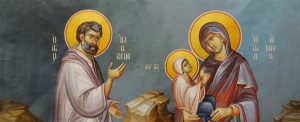
The Virgin Mary was born of a couple named Joachim and Anna, who had grown old in childlessness. All their lives they had prayed for a child but they were unable to conceive.
That heartache is familiar to many families. And being finally given a child in old age is a joyful wonder that’s familiar in stories throughout the scriptures. Abraham and Sarah were so old that when the Lord promised them a son, Sarah laughed at him. Yet she gave birth to Isaac in her old age by God’s promise. The Patriarch Jacob and his brother Esau were born to Isaac and Rebekah as an answer to prayer when she was so long unable to conceive. And we remember Hannah, who bore the prophet Samuel in her barrenness, and Elizabeth, who gave birth to the prophet and forerunner John in her old age after long years of prayer.
To the Hebrews, one of the main signs of God’s blessing was the provision of children. So the Psalmist blesses the righteous, singing, “Your wife will be like a fruitful vine within your house; your children will be like olive shoots around your table. Thus shall the man be blessed who fears the Lord. May you see your children’s children!” (Psalm 127lxx)
If obedience to God’s commandments resulted in the blessing of children, then childlessness was believed to be a sign that God was withholding his blessing – usually because someone was not keeping his law. The idea that suffering means God is mad at you was common then.
And what if the childless couple were actually righteous and obedient, as Abraham and Sarah, Isaac and Rebekah, Zechariah and Elizabeth were?
If their grief in childlessness was a sign of anything, it was that the race of mankind lives in a world broken by sin, and suffering is our companion as long as we live.
Back in Genesis, our first parents ate from the fruit of the firsthand knowledge of good and evil, of blessing and suffering, and now instead of knowing only the joy of life in the embrace of God, humans entered into the firsthand experience of pain, grief, and death.
So the many years these couples suffered in childlessness are not an exceptional wonder. But this was the setting where the Lord showed his loving kindness and great mercy, granting them a child.
Each of these miraculous births to childless couples is a signpost pointing to the day when the Lord would extend his grace to grant Joachim and Anna a child, and through her pour out his blessings on his people.
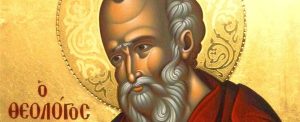
Joachim and Anna. You know those names. At the end of every Liturgy, you hear us ask for the prayers of the saints of the day, of our patron, Saint John, and of “the ancestors of God, Joachim and Anna.”
“The ancestors of God!” Well, that’s just scandalous! And that’s why we keep saying it – to keep alive the awe and surprise of it. One of the expressions we use all the time, that grates on the nerves of our Evangelical friends, is when we call the Virgin the Mother of God.
But do the math: Before the creation of the world, Christ is God the Word, a Person of the Holy Trinity. God became man; in whose womb did he do that? The whole Christian world celebrates when the living God was born in Bethlehem; who gave birth to him? Mary is the mother of the incarnate God.
And that’s not just the single biological event of childbirth. Who nursed and held the infant God? Who held his hands as he learned to walk? While “Jesus grew in wisdom and stature” (Luke 2:52), who taught him wisdom and the words of the Psalms and prayers he prayed every day?
When mankind rejected their God and hung him on a cross, who was at his feet? The only member of his family, his mother. Because she had no other sons, even while dying in the flesh, Christ our God cared for his mother and gave her into the keeping of his beloved disciple John.
We call her Theotokos, a doctrinal word that means the one who gave birth to God, but more than that, every day of his life on earth she was his mother and he was her son.
And after his resurrection and ascension to the throne of the heavens, our Lord continued to love his mother, to hear her prayers and to bless her motherly boldness in her intercessions. Just a few weeks ago we celebrated the end of her earthly life, when she not only passed away and was buried, but her Son, Christ God, received her spirit into paradise.
So we celebrate her as the Mother of God, and we honor the ancestors of God Joachim and Anna. In fact their feast day is celebrated tomorrow.
An Orthodox friend of mine attended a Protestant Bible college. When the teacher asked students to name some prophecies that predicted Christ’s birth, he was laughed at when he suggested the burning bush Moses saw.
You won’t hear that in most American churches, but we celebrate the appearance of the Lord in the bush, which shone with the light of fire but was not burned. This was a foreshadowing of the coming of the fire of God to dwell in the Virgin’s womb, which she contained without being consumed.
In fact, our hymns commemorate the Mother of God as the one who is “more spacious than the heavens.” When King Solomon built the first temple of God, he prayed, “Will God indeed dwell on the earth? behold, heaven, and the heaven of heavens, cannot contain thee; how much less this house that I have built?” (1 Kings 8:27). The heavens, in fact the whole created universe cannot contain God – Yet he was pleased to be contained within the womb of the Virgin.
And so, when the archangel Gabriel comes to this young woman in the temple, he greets her, “Hail, full of grace! The Lord is with thee.” And her cousin Elizabeth, already carrying the unborn prophet John the Baptist, greets her, “Blessed art thou among women, and blessed is the fruit of thy womb! But how am I so favored that the mother of my Lord should come to me?” (Luke 1:28,42-43).
The birth of Christ is foretold for centuries and accompanied by great wonders. Angels singing. A miraculous star that doesn’t just shine, but leads the Magi out of Persia, a thousand miles west to Caesarea to King Herod, and then south to Bethlehem. Prophecies and signs. And we prepare for the birth of Christ with fasting, and we celebrate for twelve days. Because the Almighty, most-holy God, faithful from age to age, has come and united our whole human race to his Godhead in himself, at his conception and birth in the Virgin’s womb.
But the birth of his mother is not so grand. As she was born without fanfare, or any idea of what would happen because of her, this feast comes without a lot of preparation, and it lasts just one day. Because it is not her birth that saves us.
But the key that opens the door for all the salvation work of God is her obedience. She said Yes.
She is not the Savior; her Son alone is God and man, and rules by his might forever. But she is one who comes to our aid and entreats her son for mercy. For this reason we praise her as the one through whome our salvation has come.
Saint Cleopa of Sihastria writes:
Today we celebrate the Nativity of the Queen of heaven and earth—the fruit of prayer, mercy and good deeds, received from God by the holy parents Joachim and Anna. How ought we today to celebrate; with what honor and reverence; with what holiness and purity?
Today may the barren and childless be comforted by the hope that through their alms and good deeds, fasting and prayers they too may be found worthy of children from God.
Today may the young remain in abstinence and may they celebrate in purity and honor the Nativity of the Mother of God.
Today may virgins and children exult in joy, for into the world for us has come the Mother of virginity.
Today may the old and the sick rejoice, for the staff of old age and comfort of the ailing has appeared to the world.
Today may those fallen into grievous sins and despairing of their salvation be comforted by hope, for the restoration of the fallen and the hope of the hopeless has been born on earth.
With these joyous thoughts full of hope and with hearts full of mercy and humility let us enter into the holy churches and, having kissed the icon of the Mother of God, let us raise up to Her with faith this short prayer: “Open unto us the door of compassion, O blessed Theotokos, for hoping in thee, let us not perish; but through thee may we be delivered from adversities; for thou art the salvation of the Christian race.”
To the glory of God the Father, the Son, and the Holy Spirit. Amen.