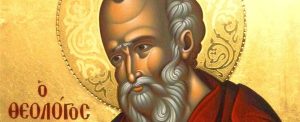
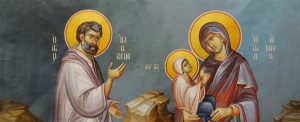
Saint Gregory of Nyssa (d. AD 394) compiled the Life of Saint Gregory the Wonderworker (d. AD 270), Bishop of Neocaesarea. In it, he recounts the visit of Saint John the Theologian, who at the request of the Mother of God explained to Gregory the Trinity.
Once, while Gregory was considering the doctrine of the faith during the night, he found himself occupied with many different arguments. At that time there were certain men who corrupted the true teaching by the persuasiveness of their reasoning, often causing even prudent people to doubt the truth.
As Gregory lay awake pondering these questions, there appeared to him in a vision someone in human form, advanced in age and clothed in a manner befitting priestly dignity. The grace of his countenance and the composure of his bearing revealed his great virtue. Astonished at the sight, Gregory rose from his bed and asked who he was and why he had come.
The figure calmed Gregory’s agitation with a quiet voice and told him that he had appeared by divine command because of the questions that were troubling him, so that the truth of the orthodox faith might be revealed to him. Encouraged by these words, Gregory looked upon him with both joy and wonder.
Then the figure stretched out his hand, as though pointing with his fingers toward someone who had appeared nearby. Gregory followed the direction of his hand and saw before him another figure, in the form of a woman whose appearance surpassed anything human. Once again overwhelmed with wonder, he lowered his face and was unable to endure the sight with his eyes. Indeed, the most remarkable feature of the vision was this: although it was the middle of the night, a light shone around those who appeared to him, as though a brilliant lamp had been kindled.
Since Gregory could not bear to look upon them, he listened as the two figures spoke with one another about the doctrine he had been seeking to understand. Through their conversation he was not only instructed in the true knowledge of the faith, but also learned who they were, since each addressed the other by name.
For he is said to have heard the one who appeared in the form of a woman ask John the Evangelist to reveal to the young man the mystery of the faith. John replied that he was willing to grant this request also to the Mother of the Lord, since it pleased her. He then set forth the doctrine in a clear and carefully ordered manner, after which they disappeared from Gregory’s sight.
Gregory immediately committed this divine instruction to writing. From that time onward he preached in the Church according to it, and he left this God-given teaching as an inheritance to those who came after him. By it his people continue to be instructed even to the present day, having remained untouched by every heretical corruption.
The words of the instruction are these:
One God, the Father of the living Word, of subsistent Wisdom and Power, and of the eternal Image; perfect, the Begetter of the Perfect; Father of the only-begotten Son.
One Lord, the Only One from the Only One, God from God, Image and Likeness of the Godhead, the active Word, the Wisdom that embraces the constitution of all things, and the Power that creates the whole creation; true Son of the true Father, Invisible from Invisible, Incorruptible from Incorruptible, Immortal from Immortal, and Eternal from Eternal.
And one Holy Spirit, having His existence from God and manifested through the Son, that is, to mankind, the perfect Image of the perfect Son; Life and Cause of the living; the holy Fountain; Holiness and the Giver of holiness. In Him God the Father is revealed, who is over all and in all, and God the Son, who is through all.
A perfect Trinity, undivided and inseparable in glory, eternity, and sovereignty.
Therefore there is nothing created or servile in the Trinity, nor anything introduced into it, as though it had not existed before but was added afterward. The Son has therefore never been lacking to the Father, nor the Spirit to the Son; rather, the same Trinity remains forever changeless and unalterable.
And whoever wishes to be convinced concerning these things should listen to the Church in which Gregory preached the word.
— Gregory of Nyssa, On the Life of Gregory Thaumaturgus, ch. 7.
Adapted from the translation provided here together with the original Greek.