Glory to God the Father, the Son, and the Holy Spirit.
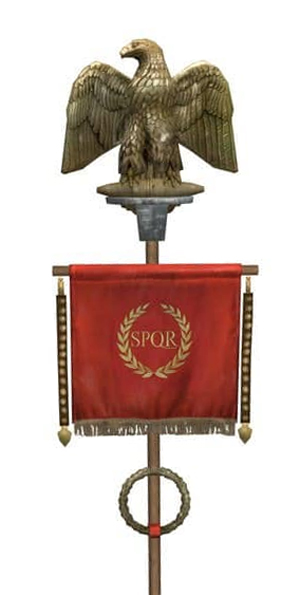 A roman standard and a trophy display.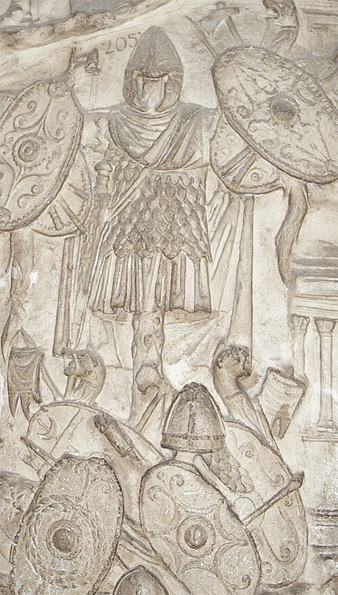
The month of September is about to get interesting! It’s been a sleepy quiet month. But it’s New Year’s Eve today. On the old, Roman calendar tomorrow is the first day of the new year. And the first great feast of the new year is the birth of the Mother of God next Monday. Then, at midweek, Bishop Peter will be in Walla Walla for their parish feast on the evening of the 23rd and the morning of the 24th: If you can be there, go and be blessed! And on the following Sunday, the 27th is the great feast of the exaltation of the cross. The choir is going to be busy!
So in two weeks we will celebrate the Cross of Christ. The kontakion or daily hymn for that feast says:
As you were voluntarily raised up on the cross for our sake, grant mercy to the new nation that bears your name, O Christ God. Make the faithful glad by your power, granting them victories over their enemies. May they have as their ally the invincible trophy, the weapon of peace.
In Roman times, a standard was a pole that an army carried into battle. With it were displayed weapons and armor – trophies – taken from defeated enemies. When they weren’t at war, an army kept its standard and trophies in a shrine where it could be saluted with respect and crowned with a victory wreath. It was like saluting a flag today. And incidentally, that’s why our image of the cross normally includes Christ. The cross is not a decorative element, it’s an icon of an event that happened and we are not ashamed of it. We don’t usually use an empty cross. After all, who salutes an empty flagpole?
Looking at the familiar sight of Roman soldiers saluting their cross-shaped standard, as far back as the 200’s Christians referred to the Cross as the Church’s trophy and standard.
Saint Clement of Alexandria calls the Church an “army of peace that sheds no blood,” whose primary allegiance is not to any worldly empire.
Gerondissa Eupraxia at the Goldendale monastery has referred to monks and nuns as the army of the Church. They enlist and enter into a life of discipline and spiritual warfare to defend us by prayers and intercessions ‘round the clock.
Father Joseph in Yakima has compared the monastics to the Rangers in Tolkien’s Lord of the Rings. The happy hobbits live their peaceful, carefree lives in the Shire, unaware that their peace is bought by the watchfulness of the Rangers who patrol and do battle with monsters outside their borders.
Most of us will not become monks or nuns, but our life is still shaped by discipline and loyalty to the Kingdom that is not of this world, our allegiance to a King who is above any law of this country or any other.
“For though we walk in the flesh, we do not wage war according to the flesh. For the weapons of our warfare are not carnal, but mighty in God for pulling down strongholds, casting down arguments and every high thing that exalts itself against the knowledge of God, bringing every thought into captivity to the obedience of Christ” (2 Corinthians 10:3-5).
There’s our spiritual warfare. Your body is not the enemy. Your body, and its actions and words, and the thoughts that drive it – these are the territory we contest to own.
For soldiers of Christ, the fasting Wednesdays and Fridays are “drill periods” for the Second Coming, when the Law of Christ will be present here on earth and Christ’s Kingdom will have no end.
If you and I are under discipline (and anyone with no disciplines is not a disciple) then how do we train? The weapons of our warfare are not carnal; disordered passions are the enemy, not any human. The old word for the disciplines of a soldier or the exercises of an athlete is: askesis.
If you’ve been taught that asceticism means hating and punishing yourself, then think instead of the athlete who goes out every morning to run, who eats and trains to make their body their servant to accomplish the things they believe they can do.
The two sides of our life as disciples are askesis and liturgy. Liturgy is our common task of lifting up to God an offering of peace, a sacrifice of praise; we are about to make that offering here this morning, and in a sense it happens whenever we offer prayers. And Askesis – exercise or struggle – is our training that consists in practicing our prayer rule, almsgiving, doing love for our family and our enemies and strangers, practicing kindness and modesty and humility, and fasting from sins, and also from foods.
Don’t make fasting all about cheese and meat: Saint John Chrysostom says that fasting is when we “visit the sick… take pity on the tortured, comfort those who grieve and who weep, be merciful, humble, kind, calm, patient, sympathetic, forgiving, reverent, truthful and godly.”
When we take up these disciplines, then we are drilling as soldiers of an army in service to an invisible King, unmercenary combatants under the banner of the Prince of Peace, and the cross of Christ is our “weapon of peace, the invincible trophy.”
From Monday through the seventh day of the week we practice these exercises of spiritual warfare in service of the King.
But on Sunday, we leave that repeating circle of days. Sunday is not only the first day of the new week; the fathers call Sunday the “eighth day.” It’s Pascha, when we celebrate the resurrection and we experience the Second Coming, the presence of the Lord. We stand at the Liturgy with all the angels and the saints, our ancestors and fathers in the faith, and even our great-great grandchildren not yet born, the Church eternal and triumphant in Christ. And his awesome and fearful presence is revealed in the consecration of bread and wine. The Lord who gave up his life “once for all” is now present for us.
When scripture speaks of the Return or Coming of the Lord, most often it’s using a word whose primary meaning is presence. Not merely the arrival of a king or official, but his presence, dwelling in and among the people, bringing justice and ordering all things.
When Christ was asked by the Pharisees when the Kingdom of God would come, he answered them, “The Kingdom of God is not coming in ways that can be observed, nor will they say, ‘Look, here it is!’ or ‘There!’ for behold, the kingdom of God is in the midst of you” (Luke 17:20-21).
After Saint Peter and Paul served the church at Antioch, their successor Saint Ignatius wrote:
Take note of those who hold differing opinions on the grace of Jesus Christ which has come to us, and see how contrary their opinions are to the mind of God… They abstain from the Eucharist and from prayer, because they do not confess that the Eucharist is the flesh of our Savior Jesus Christ, flesh which suffered for our sins and which the Father, in his goodness, raised up again. They who deny the gift of God are perishing in their disputes (Letter to the Church of Smyrna, Ch 6).
There’s a silent prayer during the Liturgy; you usually hear only the last sentence. The priest says: “Remembering … all the things that have come to pass for us: The cross, the tomb, the resurrection on the third day, the ascension into heaven, the sitting at the right hand, and the second and glorious coming again, we offer you your own, from what is your own, on behalf of all and for all.”
That prayer comes from a thousand years before Christ, when King David blesses the ground where his son Solomon will build the first temple in Jerusalem. David says, “For all things are yours, and from your own we have given to you” (2 Chronicles 29:14). This is ground you made, Lord, so I am not offering you anything that is not already yours. But I am setting it apart to be holy to the Lord. That’s why, in a few minutes, you’ll hear Father Jesse say: “Thine own of thine own we offer unto thee, in behalf of all and for all.”
So, “Remembering all the things that have come to pass for us: The cross, the tomb, the resurrection on the third day, the ascension into heaven, the sitting at the right hand, and the second and glorious coming again, we offer what we’ve received from you.” All these things have come to pass for us — including the second and glorious coming of Christ.
There are folks in America who have a whole complex chronology of events for the Last Days: The rapture, the tribulation, the mark of the beast, and all that. And there have certainly been Orthodox saints and teachers who had their own thoughts on these things.
But our dogma about the return of Christ is refreshingly simple: “He shall come again with glory to judge the living and the dead; his Kingdom shall have no end. I look for the resurrection of the dead and the life of the age to come. Amen.” Everything after that is commentary.
The return of Christ – the presence of God. When we pray, “Let thy Kingdom come, let thy will be done on earth as it is in heaven,” it means that the day when Christ rules on earth as King, when all the world will be set right, is coming. And we pray, Lord, bring it here and now! But it’s more than that. The Kingdom has already come. It’s here, breaking into this moment.
Do you remember the Kool-Aid TV advertisement throughout the 1970s? Kids are hot and thirsty, and then a gigantic animated pitcher of Kool-Aid crashes through the wall into the room.
In places with hurricanes, before a storm they board up the windows – because otherwise the hurricane wind will break through into the house and turn everything upside-down.
Wherever God’s will is being done, here and now, the Kingdom has come breaking into this world, disrupting and turning everything upside down. The Day of the Lord has appeared, for a moment, here in the middle of your day. Heaven on earth.
When your kids take up their cross, forgive one another and practice patience; when you have the opportunity to help someone with a word or a meal or a rent payment; when a familiar temptation comes up, and with peace you simply don’t worry about it and it passes by – then the Kingdom has come, in that moment God’s will is done on earth as it is in heaven. And your passions and sins have been shaken by the Kingdom that cannot be shaken (Hebrews 12:28).
Here’s another way to think about it. The Kingdom of God is in the future, but it’s like a time machine. Grace is when something from the future, something joyful and powerful and creative and alive, shows up in the middle of today. Here it is, right in front of us, this piece of the future, this bit of heaven. The God of grace, by his presence, starts healing our passions, empowering us to do love to our family and our enemies, making us stand in a firm and level place and to be victors and wellsprings of the life of God.
But there’s more: If you are a Christian, then the Kingdom of God isn’t just a time machine from the future. You are the time traveler from the future. You don’t belong here to this time and place (Hebrews 13:14).
Sons and daughters of the Kingdom of God are no longer strangers to grace, no longer aliens separated from the communion of saints; now we are citizens with the saints in the Kingdom of God, joint heirs and members of the household of God. (Ephesians 2:19) We are subject to the law of the Kingdom of God (Matthew 22:34-40; James 2:8).
You’re from the future, but living in today’s world. Which means that, like a time traveler, you know how it all ends. You’ve seen the future. And that lets you know how to live today (Ephesians 5:8-9).
Knowing the end of the story, you’re going to live in a way that won’t make sense to a lot of people. They will look at you and ask, “Why are you doing this? You people are crazy.” And you can say, “I know it looks that way. But what I’m doing actually makes a lot of sense. You see, I’m from the future. And I’m acting this way because I know how the story ends.” Not crazy at all.
There is a saying, in our culture that “the end justifies the means.” That is, if you have a goal that is great and worthy and good, then whatever methods you use to get there, even if they’re troubling, they’ll be OK in the end. But the fact is the end doesn’t justify the means. In fact the methods and actions you choose shape the results. If your actions and choices and thoughts are not lined up with the righteousness of Christ, then in the end, what you shape yourself into may be some thing that is not at home in the presence of God. So we live toward the resurrection, and that’s got to shape our whole lives now.
And how does the story end? At the end of all things, Saint John says:
I saw the holy city, New Jerusalem, coming down out of heaven from God, prepared as a bride adorned for her husband. And I heard a loud voice from heaven saying, “Behold, the dwelling place of God is with men, and he will dwell with them, and they shall be his people… And God will wipe away every tear from their eyes. There shall be no more death, nor sorrow, nor crying. There shall be no more pain, for the former things have passed away.”
And the Spirit and the bride say, “Come!” And let him who hears say, “Come!” And let him who thirsts come. Whoever desires, let him receive the water of life freely. He who testifies to these things says, “Surely I am coming quickly.” Amen. Come, Lord Jesus! (Revelation 21:2-4; 22:17,20).
To the glory of God the Father, the Son, and the Holy Spirit. Amen.