The painting above is John William Waterhouse’ 1891 painting Ulysses and the Sirens. About this painting Dr Ted Gott writes:
The Sirens, who with their melodious voices lured all navigators to destruction … were, according to classical tradition, creatures having the body of a bird with the head of a beautiful woman … They were informed by the oracle that as soon as any passed by without heeding their songs they should perish. Ulysses [the Roman name for Odysseus], warned by Circe, stopped [with wax] the ears of his companions and ordered himself to be bound to the mast, and so successfully passed the fatal coast.
Apollonius of Rhodes in his third century BC Argonautica calls the Sirens daughters of the muse Terpsichore:
Fashioned in part like birds and in part like maidens… The clear-voiced Sirens used to beguile with their sweet songs whoever cast anchor there, and then destroy him. Ever on the watch from their place of prospect with its fair haven, often from many [sailors] had they taken away their sweet return, consuming them with wasting desire; and suddenly to the [Argonauts], too, they sent forth from their lips a lily-like voice. And [the sailors] were already about to cast from the ship the hawsers to the shore, had not Thracian Orpheus, stringing in his hands his Bistonian lyre, rung forth the hasty snatch of a rippling melody so that their ears might be filled with the sound of his playing; and the lyre overcame the maidens’ voice.
Lycophron in Alexandra (third century BC) calls the Sirens harpy-limbed or bird-limbed nightingales, and describes how they died after Odysseus escaped their trap. The three threw themselves into the sea and washed ashore in southern Italy.
In Euripides’ Helen (412 BC), Helen calls upon the Sirens to join her mourning. She asks the “winged maidens” to accompany her lament with flute, pipe, or lyre and calls their music “songs of death” suitable for Persephone. The Sirens sing a lament for the dead dwelling below.
These beings promise understanding of the future and of divine mysteries.
Why were Sirens envisioned as a hybrid bird-woman? Birds as symbols were common in the Greek mythic imagination. Birds were used to represent everything from oracles, enchantresses, messengers of deities, and mediators between the human world and the supernatural realm. The Sirens are part of the same tapestry as the harpies and the sphinx.
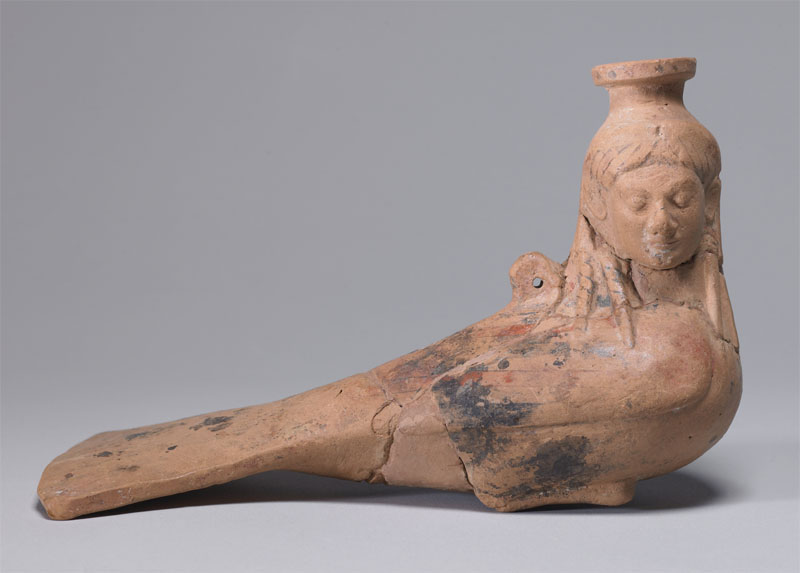
Perfume vase in the shape of a Siren, c. 540 BC.
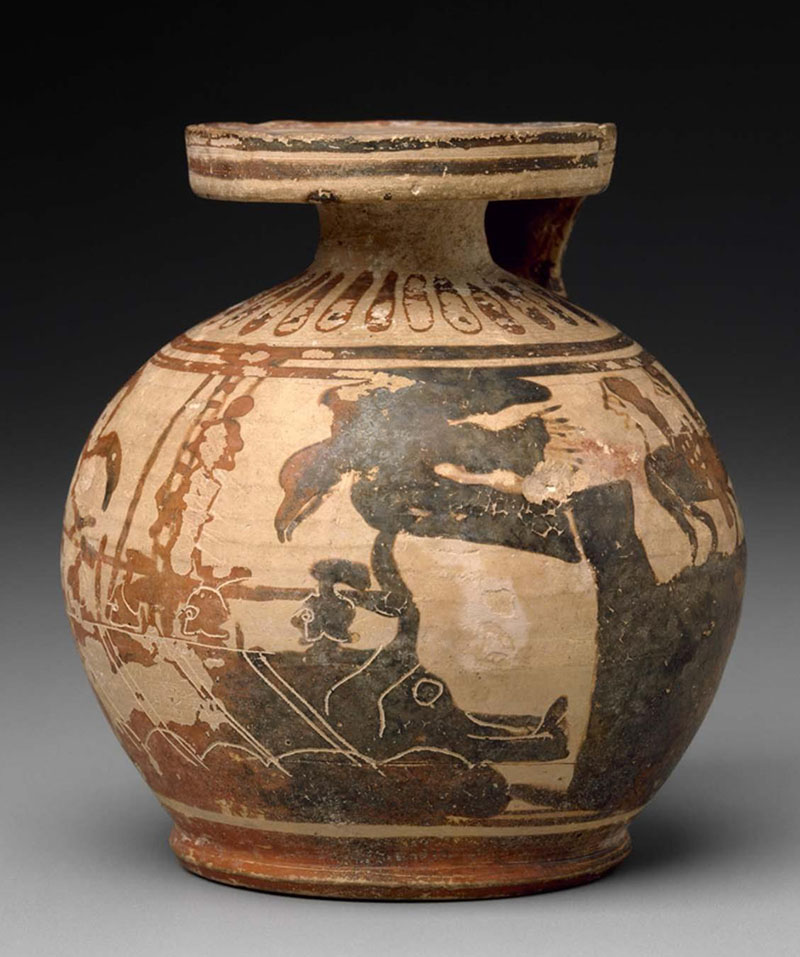
Oil flask with Odysseus confronted by Sirens, c.550-575 BC.
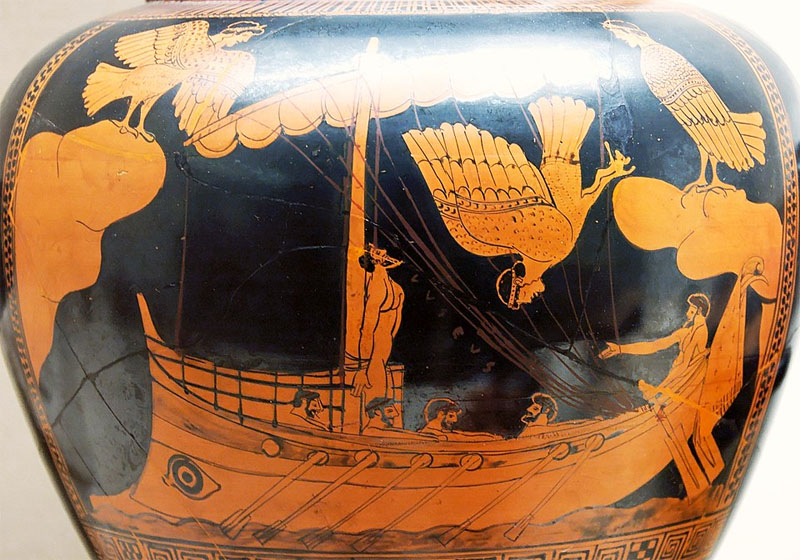
Attic vase, Odysseus and the Sirens, c.480-470 BC.
Jane Ellen Harrison writes in Prolegomena to the Study of Greek Religion that in classical literature,
[Sirens] appeal to the spirit, not the flesh,” since “the desire to know – to be as the gods – was the fatal desire… The Sirens, though they sing to mariners, are not sea-maidens; they dwell on an island in a flowery meadow. They are mantic creatures like the Sphinx with whom they have much in common, knowing both the past and the future. Their song takes effect at midday, in a windless calm. The end of that song is death. It is only from the warning of Circe that we know of the heap of bones, corrupt in death – horror is kept in the background, seduction to the fore.
In the Odyssey, here is the song the Sirens sing to lure Odysseus:
Famous Odysseus, great glory of Achaea, draw near, and bring your ship to rest, and listen to our voices. No man rows past this isle in his dark ship without hearing the honeysweet sound from our lips. He delights in it and goes his way a wiser man. We know all the suffering the Argives and the Trojans endured, by the gods’ will, on the wide plains of Troy. We know everything that comes to pass on the fertile Earth.
In the Middle Ages, Christian representations of the Siren evolved from a bird-woman into a half-fish, half-woman, who personified the dangers of both the sea and female sexuality. The seventh-century Liber monstruorum diversis generibus, or Book of Monsters, is one of the earliest examples of this transition, describing Sirens as sea-girls who “are like human beings from the head to the navel, with the body of a maiden, but have scaly fish tails, with which they always lurk in the sea.” Illustrations from the period clearly reveal the difference; the Sirens now have voluptuous bodies, and exhibit brazen tactics of seduction such as staring longingly into mirrors and combing their hair. These Sirens no longer threatened the spirit, but now represented the danger feminine beauty posed to male virtue.
In the 19th-century, Sirens and mermaids were a popular artistic motif. Ravishingly beautiful and sensuous, they seduced and lured passing sailors. Recalling this nautical metaphor, in 1971 Starbucks Coffee, Tea and Spices adopted as its logo a 15th-century woodcut of a bare-breasted Siren posing seductively.
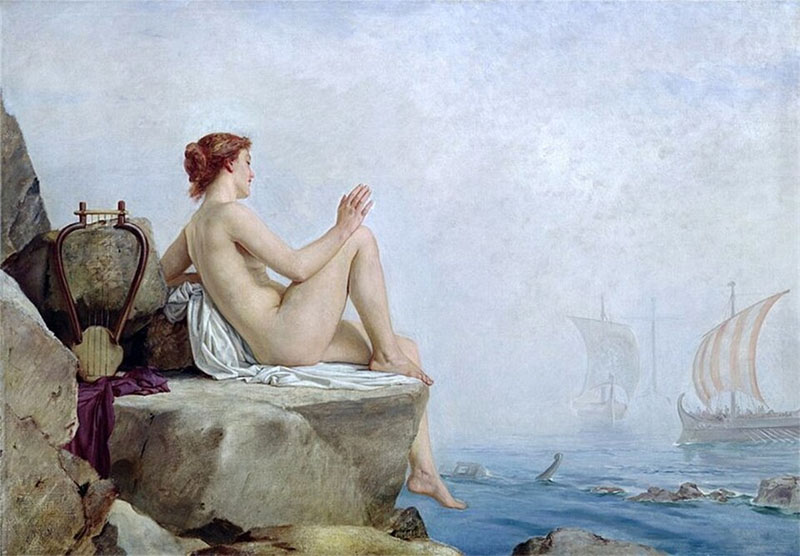
The Siren, Edward Armitage, 1888.
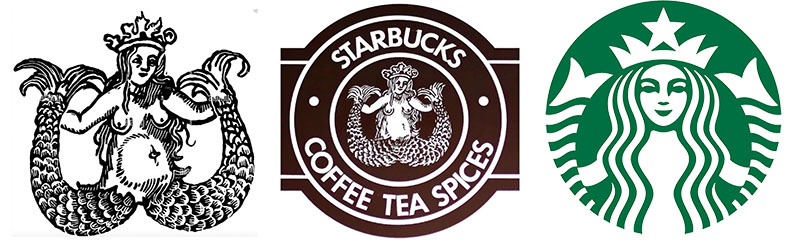
Starbucks Coffee logo.
In the European imagination, these otherworldy Sirens, with their songs promising forbidden knowledge to tempt human seekers to their doom, are reduced to symbols of female beauty, a threat against which men must be vigilant.
Sadly, in modern retellings, the Sirens are no longer interesting – merely pretty.