Original in Turkish at posta.com.tr
Archaeologists in southern Turkey have uncovered five carbonized loaves of bread dating to the 7th–8th centuries AD, offering a rare glimpse into early medieval Christian life and worship. The discovery was made during excavations at Topraktepe, the site of the ancient city of Irenopolis in Karaman Province.
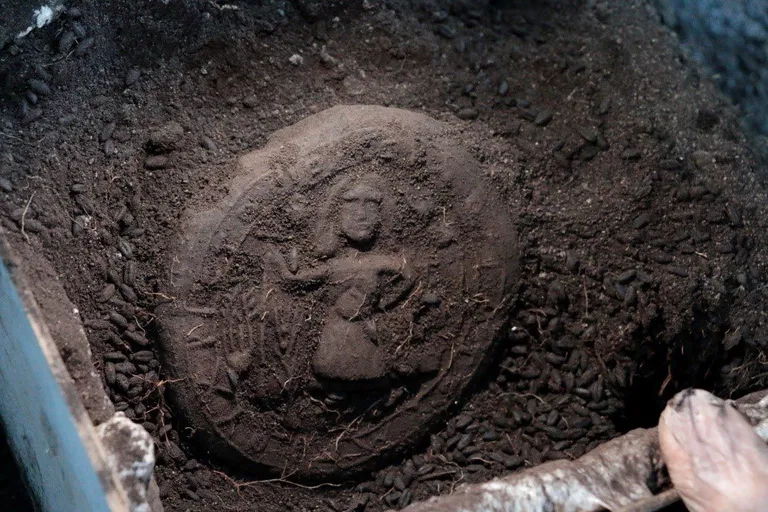
One of the loaves is particularly remarkable for bearing a depiction of Jesus alongside a Greek inscription reading “With thanksgiving to the blessed Christ.” According to epigraphic analysis, the image represents not the familiar “Christ Pantocrator” [Ruler of All] but rather “Christ the Sower” or “Christ the Farmer.” Archaeologists suggest this iconography symbolizes fertility, labour, and sustenance—values that held deep spiritual meaning in the early Christian world.
Four other loaves bear imprints in the form of a Maltese cross. Experts believe these decorated breads could have served as Eucharistic or prosphora breads used in early Christian liturgy. Their combination of religious imagery and inscriptions strongly points to ritual use within the community.
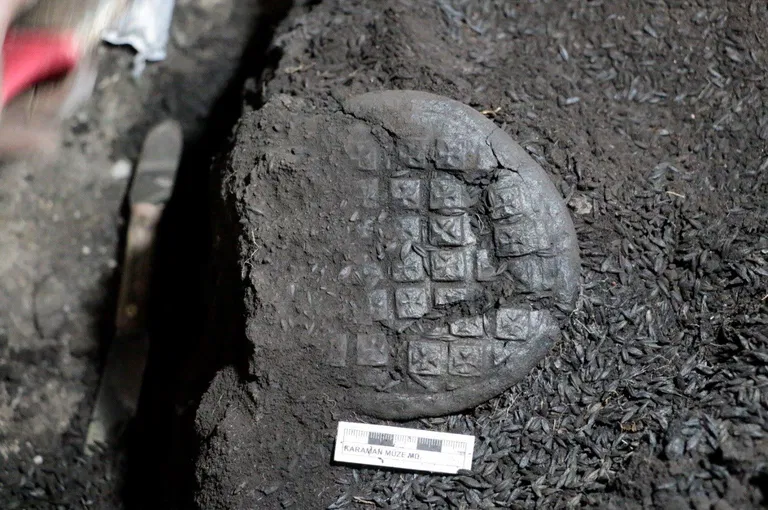
At the same time, the barley flour used in their baking reflects ordinary dietary habits of the region, bridging the worlds of faith and daily sustenance. Researchers note that these finds illuminate both the spiritual and material dimensions of life in early medieval Anatolia.
The breads survived nearly thirteen centuries thanks to a process of carbonization—likely caused by fire or exposure to intense heat in anaerobic conditions—which preserved their shapes and surface details in striking clarity. Their imprints and inscriptions remain clearly visible, making them among the best-preserved examples ever found in Anatolia.
Local officials have described the discovery as a “rare example” of early Christian material culture, shedding light on how religious symbols were integrated into the daily rituals of believers.
The excavations at Topraktepe are conducted under the direction of the Karaman Museum Directorate, with permission from Turkey’s Ministry of Culture and Tourism, Directorate of Cultural Assets and Museums. The project is supported by Selçuk Pharmaceutical Depot and Kazancı Municipality Construction, Agriculture and Livestock Industry Trading Ltd.
The discovery of these loaves adds to the growing archaeological evidence that the region of Eirenopolis was an active Christian centre during the early Middle Ages—where even something as humble as bread could serve as a vessel for devotion.