Luke 8:41-56
Glory to God the Father, the Son, and the Holy Spirit. Amen.
Last week, we read that the Lord got into a boat, and went across the Sea of Galilee to a place where there was a violent demonized man living naked in the graveyard. And now Saint Luke writes, he is “clothed and in his right mind,” sitting at the feet of Jesus. The whole trip across the Sea of Galilee was for this man. Now the Lord has set him free, and goes back to Galilee. It’s been a busy day or two already, and there’s a crowd waiting for the Lord, hungry for more miracles and teaching.
Now we hear that there’s a pious man whose daughter is dying. Of course the Lord says “I’ll come.” The crowd follows him, surrounding and pressing in on one another.
Then the Lord stops and says, “Who touched me?”
Now from time to time the Lord asks questions not to gain information but to make someone answer. In Paradise, the all-knowing Creator did not wonder where Adam had got to; he called out, “Adam, where are you?” to get Adam to answer. “Who told you that you were naked? Have you disobeyed me?” is the same as when a priest asks you what sins you’ve come to confess, because you have a need to say these things, and hear yourself say these things, out loud.
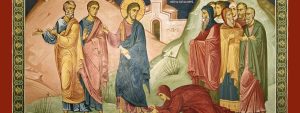
“Who touched me? …I could tell power went out from me.” Now when the woman saw that she was not hidden, she came trembling; and falling down before Him, she declared to Him in the presence of all the people the reason she had touched Him and how she was healed immediately.
She came trembling — why? Because under the Jewish law, a person who touched blood or a dead body was separated for seven days, and anyone who touched them was made unclean as well. That meant a Jewish woman on her monthly period, or immediately after giving birth, couldn’t enter anyone else’s home, or the Temple, and anyone or anything she touched shared her separation.
Now, to be clear, Jewish ritual impurity is not sin (how could anyone repent from what a healthy woman’s body does every month?) In fact ceremonial uncleanness or ritual impurity is an interpretation – the Hebrew word literally means distance.
Under the Jewish law, impurity visibly separated a person from their family and from shared sacred acts. And as long as this woman had this condition, anybody that this woman touched would contract a state of ritual uncleanness from her.
This woman is right to be afraid. If the crowd that’s been pressing against one another realize that she has just made many of them unclean by touching her, how angry are they going to be? And she’s not just bumped into however many people in the crowd; she has just publicly touched the Teacher Jesus. What is he going to say!?
But the Lord turns the tables on expectations. The touch of the woman doesn’t make him impure: Instead, He makes her clean.
He does the same thing in another passage (Matthew 8:3) when he touches a leper. Lepers were commanded to live outside the camp, and aways call out “Unclean! Unclean!” so no one would come near them and catch their disease or their ritual impurity (Leviticus 13:44-46). But when the Lord touches a leper, the leper does not make him sick or unclean: The Life of God makes the leper clean and whole.
And when people were coming to John the Baptist to repent and wash their sins away, the Lord came with them. John was confused, because the “Lamb of God who takes away the sins of the world” (John 1:29) has no sins to wash away: “I need to be baptized by you! How are you coming to me?” (Matthew 3:14). But he obeys and immerses the Creator of the world in the water. When the sinless God incarnate enters the Jordan river, the muddy water doesn’t make him clean: He makes the waters pure and holy.
Jesus doesn’t get wet — the water gets Jesus.
That’s why we bless water repeatedly throughout the year, and then we use that blessed water to communicate the power of God into our homes, our bodies, our vehicles and livestock and crops. We bless everything – to visibly, tangibly invade this world with the Kingdom of God. “Let thy kingdom come, here and now. Let thy will be done on earth, as in heaven” (Matthew 6:10).
You can see in this a figure of the salvation of the world. The living God enters into the human race, unites himself to fallen Adam, and unites all mankind to the life of God. You know we look for the resurrection of the dead and the life of the age to come – but it’s not just our bodies will be renewed. Saint Paul says,
The whole creation waits in eager expectation for the children of God to be revealed. For the creation was subjected to futility, in expectation that the creation itself will also be delivered from the bondage of corruption into the freedom and glory of the children of God. We know that the whole creation has been groaning as in the pains of childbirth right up to the present time. Not only that, but we ourselves, who have the firstfruits of the Spirit, even we groan within ourselves, eagerly waiting for the adoption, the redemption of our body (Romans 8:19-23).
This world that has been shattered by sin and made to suffer in violence and pain – into this world has come the living God who made it in the beginning, to unite it to his own divine life and wholeness.
Where Christ comes, he brings all things into union with himself.
* * *
Christmas is coming in only a couple of months, and of course we all look forward to brightly-wrapped presents under the tree – each gift is a thing that someone has made or picked out to give to us.
When we see our sins and shortcomings we want to ask God to grant us the gift of wisdom, give us the virtues we lack, impart to us his righteousness.
But many years ago, I stumbled over 1 Corinthians 1:30, which says in its delightfully twisted King James grammar: “Of him are ye in Christ Jesus, who of God is made unto us wisdom, righteousness, sanctification, and redemption.”
Straighten out the kinks in that sentence, and we get: God has united you to Christ; and Christ himself is your wisdom, your righteousness, your holiness, and your reconciliation.
Banish from your mind the idea that our God intends to give you righteousness as a gift, a thing, apart from himself. Justification, sanctification, salvation, is not an impersonal thing. When God the Word entered into our race he himself became all the righteousness we will ever have. Do we lack holiness, wisdom, love, or perseverance? Well, those are attributes of God. Jesus Christ is wisdom in us; he is love and courage and perseverance in us. And as we become increasingly partakers of the divine nature, we increase in bearing the fruit that reveals who he is.
When you plant a garden, you wait and water for what seems like a long time, but in time you see sprouts. They grow, and finally around May you get your first green bean or lettuce. Hurray! First fruits! You know that before summer is over you will have so many zucchini and tomatoes you’ll have to give them away. But there is joy in the spring when you see the first indication that this works – your garden is bearing fruit.
Your life is a struggle, a long obedience in the same direction. And the holiness of God, the righteousness of the saints, seems pretty far from the reality we see in the mirror. But hold onto the fact that “he who has begun a good work in you will bring it to completion until the day of Christ Jesus” (Philippians 1:6). Did you refrain from a sarcastic comment today? Did you keep your promise? Was someone a jerk to you and you let them be? Celebrate that first fruit! And know that it’s a sign of the fulfillment to come.
* * *
So when this woman touches the Lord, he says to her, “Daughter, be of good cheer; your faith has made you whole. Go in peace” (Luke 8:48)
“Your faith has made you whole.” The Lord will say that seven times before the Gospels are over (Matthew 9:22; Mark 5:34; 10:52; Luke 7:50; 8:48; 17:19; 18:43), the same exact words in Greek.
In some places it’s translated “Your faith has made you whole.” And in other places translators render it: “Your faith has saved you.” They make that decision based on whether Christ seems to be healing a sick person or forgiving a sinner; but it’s a translator making a choice. The word “salvation” means wholeness, preservation, rescue, safety.
A person who has been saved from their sins is one in whom the damage and compulsion of sins have been healed, whose heart and relationships are conformed to the love of God. Who’s been transfigured into the likeness of Christ. A person who has begun to be saved is one in whom the Holy One has begun to become “clean hands and a pure heart” (Psalm 24:4KJV).
But us? We’ve been to confession for the sins that have plagued us for years. We’ve been to confession so many times, fallen and risen fallen, and we’ve felt like an unworthy, unclean leper in the midst of the worthy ones.
Saint Ambrose of Optina told this story:
One ascetic woman was besieged for a long time with unclean thoughts. When the Lord finally came and cast them away from her, she called to Him: ‘Where were you before now, O my sweet Jesus?’ The Lord answered: ‘I was in your heart.’ She said then: ‘How could that be? For my heart was full of unclean thoughts.’ The Lord said to her: ‘Know that I was in your heart, for you were not disposed to the unclean thoughts, but strove rather to be free of them. And when you were not able to be free, you struggled and grieved. By this you prepared a place for Me in your heart.’
Struggle and pursue holiness. Fall and rise again and have no shame, but come right to the throne of Grace and receive mercy. The Lord is not charting your progress, grading your performance, and you shouldn’t be either.
If you are prepared to receive Communion today, then come to the cup “with the fear of God, with faith and love.” This morning we are not merely going to steal a touch of the hem of Christ’s garment, but we’ll receive his living Body into our body, and put his living Blood in our veins. Where Christ comes, he brings all things into union with himself.
With audacity we are going to trust the One who calls us and says “Never will I leave you, never desert you” (Hebrews 13:5), and “Come to me, all you who are weary and burdened, and I will give you rest. (Matthew 11:28).
To the glory of God the Father, the Son, and the Holy Spirit. Amen.