Anu at Medium writes:
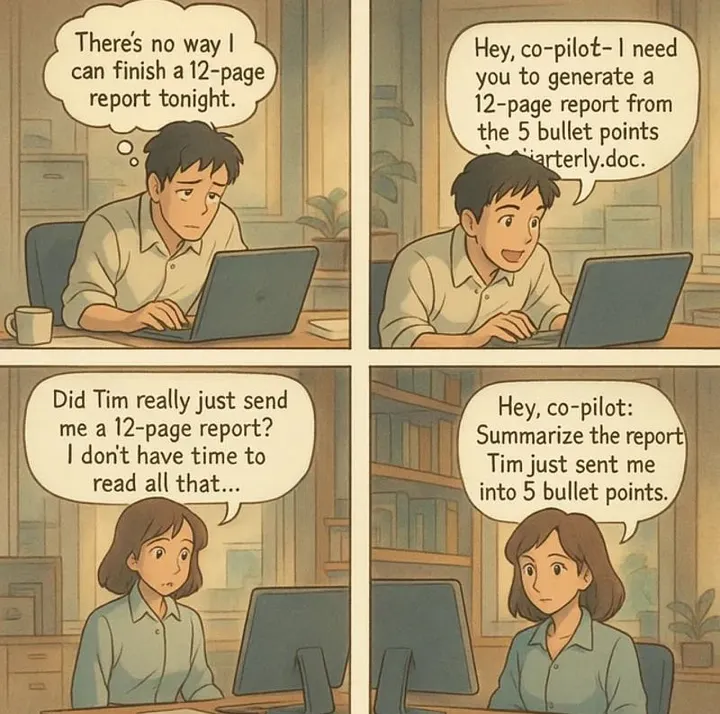
I came across two pieces of content recently that really got me thinking. The first was this comic strip showing our modern workspace reality — humans increasingly outsourcing their thinking to AI. Humorous, yet unsettling.
Almost simultaneously, I stumbled upon a brilliant post by a Princeton professor who very sharply connected AI adoption to the decline of critical thinking, and linked it to what he sees as the gradual dismantlement of democracy. His argument felt kind of inevitable.
The Two Types of Reading We’re Losing
The professor argues that people read for two purposes: pleasure or entertainment, and second for seeking information. Leisure reading has been shrinking for years with tough competition from video. With attention spans shrinking and moving to shorter and shorter bytes, reading pages at a stretch will continue to decline. We’ve moved from novels to articles to tweets to TikToks.
But it’s the second type of reading, information seeking, where AI’s impact is most concerning. This comprises people who were earlier skimming through text to gather information. Google search made it easier by listing top pages, and AI is making it even easier by not even needing us to skim information.
The result? The very act of opening up a book or a text starts feeling like a chore.
What We’re Really Losing
What ultimately starts eroding is our ability to do critical thinking. And critical thinking, reading, and questioning is what our democracies rest on. When you read, you think. When you think, you question. When you question is when you challenge the status quo.
Then just last week came that study from MIT on what using AI is doing to our brain — it sort of validates these concerns. While the sample is small and it’s not peer reviewed, it’s still damning. The study shows measurable impacts on cognitive function from AI dependency, especially concerning for the younger population.
The Productivity Myth
We keep saying that AI will free up time for people to do what they like to do. But what do our people really end up doing? Consuming more and more content. It’s junk food for the brain plus no exercise since you’ve outsourced brain thinking to AI.
This isn’t abstract anymore. We’re beginning to see concrete evidence of what many of us suspected — that outsourcing our thinking is fundamentally changing how our brains work.
The New Cognitive Elite
Here’s what really worries me: while most of us are gradually outsourcing our thinking to AI, there’s a small group of people who aren’t. The ones making strategic decisions about AI deployment.
The result isn’t just inequality of wealth — it’s inequality of thinking capability itself. Power will concentrate in the hands of those who can still think independently, who understand how these systems work, and who shape how they’re deployed.
Think about it: if you can’t read a complex document, analyze competing arguments, or synthesize information independently, how can you meaningfully participate in decisions about AI governance, economic policy, or democratic representation? You become dependent not just on AI systems, but on the humans who control them.
When wealth was the primary source of advantage, there were always paths to mobility through education or hard work. But when the advantage is thinking capability itself — the ability to reason and understand — the barriers become far more fundamental.
We’re outsourcing our agency. And in doing so, we’re creating a world where a small number of people who retain the ability to think independently will have unprecedented influence over those who don’t.
Via: Anu at Medium