Sunday before Christmas
Hebrews 11:9-40; Matthew 1:1-23
Glory to God the Father, the Son, and the Holy Spirit. Amen.
Well, here we are, in the first week of January. I hope everyone had a merry Christmas, if not a white Christmas, and a happy new year celebration. Now it’s almost Christmas again! How does that happen?
Short answer: 500 years ago, the Pope of the Roman Catholic Church changed his calendar. Over the next couple of hundred years, Protestant countries one by one adopted the new calendar as well. In the 20th century, the communists imposed the new calendar in Russia, and the Greek government and church adopted the new calendar as well. But Christians in Jerusalem, Mount Sinai, Serbia, Russia, Mount Athos, and elsewhere stuck with the calendar that we were using already. The difference is about two weeks, which means that December 25 is actually this coming Wednesday.
This morning, on the Sunday before the Nativity of Christ, we commemorate the holy Ancestors of Christ. Last week was the Forefathers of Christ: All those saints, known and unknown who lived before the Law and under the Law, from Adam until John the Forerunner.
Now today we have read the genealogy of Christ.
In my experience, there is a difference between cat people and dog people. I hear dog people say things like, “This is my handsome boy General Kenobi Hakuna Matata Pontefract! He’s a pedigree Aussiedoodle and I paid $3000 for him last September and I finally got to take him home today,” and they can show you his Kennel Club family tree and official pedigree. Cat people are more like, “This is Fred. I found him in my trash.”
How many of us, when we read the Gospel according to Saint Matthew, skip over the begats? Abraham begot Isaac, begot Jacob …um… Joseph the husband of Mary, there we go! Most of us in our culture would have a hard time remembering our great-grandparents’ names.
But there are cultures where, if you can’t introduce yourself and name a good seven generations of your ancestors, you’re saying you are nobody. In these cultures, when an apostolic missionary begins his account of the work of Christ with a genealogy, he catches everyone’s attention: Sit up straight and pay respect; this is someone important.
The Hebrews were a patriarchal culture, so what we have is a list of fathers. With five exceptions. It’s a list of revered elders and famous ancestors to brag about. With five exceptions.
It’s not just interesting that there are five women in this genealogy; look them up and it’ll become apparent that they are five scandalous women.
Tamar, who had to resort to deception and pose as a prostitute to obtain the legitimate son the Law entitled her to.
Rahab, the prostitute at Jericho who saved the Hebrew spies.
Ruth, the unclean Moabite foreigner, who became the wife of Boaz and grandmother of King David.
Bathsheba, whom David used for his sins of adultery and murder.
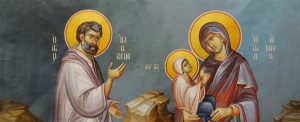
And finally Mary, the teenaged temple virgin, betrothed to the elder Joseph, who was discovered to be pregnant. Joseph was minded to put her away until an angel convinced him that Mary’s child was a miracle from God. Our tradition suggests Joseph continued to have doubts.
In the Akathist of the Nativity, we sing: “The chaste-minded Joseph, who before had within him a storm of doubting thoughts, now beholds all-glorious things within the divine cave [of the Nativity]” (Kontakion 4). In many Nativity icons, even as the Virgin and Child are at the center, off in the margins you’ll see Joseph being tempted by a stranger who is whispering slander in his ears.
Joseph wasn’t the only one with suspicions: The Jewish books called the Talmud describe Jesus as the son of an adulteress, by some random Roman soldier.
But the Virgin Mother of God is not ashamed to be numbered with these scandalous women, who found favor with God through their faithfulness, and who are numbered among the honored Foremothers of Christ.
The Lord delights to take us out of our pain and wounds and poverty and pour out the riches of his grace. “Blessed are the poor in spirit – the ones who have nothing to offer him – for the kingdom of heaven is reserved for them” (Matthew 5:3).
Saint John Chrysostom says that Christ was not embarrassed by the skeletons hidden in His ancestors’ closets. The conclusion of the genealogy is the beginning of a new generation. The age of preparation and promise is over; the fullness of time has come.
Saint Matthew begins his Gospel by looking back to the first words of the Hebrew Bible. It opens with, “In the beginning, God created.” So in Hebrew that book is named from its first word, Bereshit, “In the Beginning.” Our Greek Old Testament translates that name, so in our Bibles it’s named Genesis.
Saint Matthew’s opening words are: Βίβλος γενέσεως Ἰησοῦ χριστοῦ, The book of the genesis of Jesus Christ. He is consciously writing the new Genesis to chronicle the origin of the age to come, the new covenant. This is not the story of sweet little Baby Jesus laid in a manger – it’s the prologue to the announcement that a new King has begun to reign and is coming to judge the earth. The Kingdom of God is at hand (Matthew 3:2; 4:17; Mark 1:15). In the Wisdom of Solomon, we read:
While gentle silence enveloped all things, and night in its swift course was now half gone, thine Almighty Word leaped down from heaven, out of thy royal throne, as a fierce man of war into the midst of a land of destruction, and brought thine unfeigned commandment as a sharp sword (Wisdom 18:14-16).
The ancient Jewish commentary on Isaiah 9:6 reads: The prophet said to the house of David, For unto us a child is born, unto us a son is given, and he has taken the law upon himself to keep it. His name is called from eternity wonderful, the mighty God who lives to eternity, the Messiah whose peace shall be great upon us in his days (Targum Jonathan).
“He will save his people from their sins,” the Gospel says (Matthew 1:21). Chrysostom reminds us, “He becomes flesh; his divine nature unchanged… and all sinners come to see the Lamb of God who takes upon himself the sin of the world… O unutterable grace! For the Ancient of Days has become a child” (Homily on the Nativity of Christ).
The Lord said, “The Kingdom of God is in your midst” (Luke 17:21). And at Christmastime we’re reminded that Emmanuel means “God With Us.” That should also be a sobering reality. At Great Compline, on Tuesday night, we’re going to sing Isaiah chapter 8, with the repeated refrain “For God is with us.” That’s meant to bring to mind the armies of the Hebrews, advancing against their enemies to defend themselves, carrying the Ark of God’s presence:
God is with us. Understand, all ye nations, and submit yourselves: For God is with us.
Hear ye, even unto the uttermost ends of the earth: For God is with us.
Submit yourselves, ye mighty ones: For God is with us.
If again ye shall rise up in your might, again shall ye be overthrown: For God is with us.
And the refrain is repeated again and again, to exhort the faithful to courage and perseverance, and to literally put the fear of God in our enemies. “For we wrestle not against flesh and blood, but against principalities, against powers, against the rulers of the darkness of this world, against spiritual wickedness in high places” (Ephesians 6:12). For God is with us!
The kingdom of God suffereth violence, and the violent take it by force (Matthew 11:12).
The Canon of the Nativity begins: “Christ is born, glorify him! Christ comes from heaven, go to meet him!”
The hymns of the feast exhort us to accompany the kings and shepherds and go to meet him. There’s no sentimental Hallmark holiday season in mind here, but rather a call to action.
And as we go to meet Christ in his nativity, we call to mind the sermon of John the Forerunner and Baptist, preaching “Prepare ye the way of the Lord” (Mark 1:3). He’s quoting the prophecy of Isaiah:
The voice of one crying in the wilderness: Prepare the way of the Lord! Make straight in the desert a highway for our God. Every lowly valley shall be raised up, and every proud high place will be brought low; the crooked places shall be made straight and the rough places smooth. The glory of the Lord shall be revealed, and all flesh shall see it together; for the mouth of the Lord has spoken (Isaiah 40:3-5).
This is the work of preparation. To come to the feast of the Nativity with a heart ready for the grace of God takes some attention.
I entreat you therefore, brethren, by the mercies of God, that you present your bodies a living sacrifice – holy, acceptable to God – which is your reasonable service. And do not be conformed to this world, but be transformed by the renewing of your mind, that you may prove what is that good and acceptable and perfect will of God (Romans 12:1,2).
We’re read this morning how the saints, “through faith,” were accounted righteous by God.
In our American popular religion, there is a notion that righteousness is a result of faith alone. That you and I can be saved and healed and made free from our sins, perfected and made righteous and holy, by belief and nothing else. You know, the Bible does mention “Faith alone.”
What does it profit, my brethren, if someone says he has faith but does not have action? Can faith save him? Suppose a brother or a sister is without clothes and daily food. If one of you says to them, “Go in peace; keep warm and well fed,” but does nothing about their needs, what does it profit? In the same way, faith alone, if it is not accompanied by action, is dead. (James 2:14-17).
The apostle James is dismissing the kind of faith that consists of opinion without action. When we marry, we commit to be faithful to our spouse. Unless we are unfaithful. This is what the US Marines motto means: Semper fidelis is “ever faithful.” It’s a commitment to fulfill our promise.
What does the action of faith look like? Saint Paul writes to the Galatians:
Brethren, you were called to be free. But do not use your freedom to indulge the flesh; rather, serve one another humbly in love. For the entire law is fulfilled in keeping this one command: “Love your neighbor as yourself.” (Galatians 5:13,14).
That’s a command familiar to us from the Law and the Gospels. But what does it look like with its boots on, here and now in the real world? Some specifics would be helpful. Well, if you grew up in church, you probably learned the next verse in Sunday school and maybe you can say it with me:
The fruit of the Spirit is love, joy, peace, patience, kindness, goodness, faithfulness, gentleness, self-control. Against such things there is no law (Galatians 5:22-23).
That’s in Galatians, chapter 5, and if it’s not familiar to you, then I counsel you to go home and read it.
Every one of those virtues – Love, joy, peace, patience, gentleness, and the rest, are action words. In scripture we are commanded again and again to do love, to rejoice, to be peace-makers, and so on. A healthy tree bears fruit, and so does a disciple of Christ.
All over the Gospels, we see the Lord commanding people to do the impossible. To a paralyzed man, he says, get up and carry your mat. To the man with the withered hand, he orders him to do the one thing he cannot do: stretch out your hand. And as they resolve to obey the impossible command, in the power of God, the miracle happens. Peter, get out of the boat and walk on the water. It’s when Peter obeys the impossible command that he receives the power to obey.
And so the Lord gives us commands to action that we don’t have in us. Forgive. Give thanks. Be patient. Do justice. Love mercy. Be holy as I am holy. Not because we have the ability to do all these things, but because he intends to accomplish these things in us, as we offer up our little obedience.
This is why we read in scripture, “God is glorified in his saints” (Ps 68:35lxx; 2 Thessalonians 1:10), and our fathers and mothers were approved by God through faithfulness in action (Hebrews 11:39).
So today we prepare the way of the Lord, and we make haste together to the Nativity of Christ. From the vigil:
Bethlehem has opened Eden. Come, let us see! We have found joy in a secret place. Come, let us seize Paradise hidden in the cave! There the has appeared the Root no man has watered, blossoming with forgiveness. There is found the Well which no man dug, from which David longed to drink of old. There the Virgin has borne a child, quenching Adam’s thirst and David’s. Let us hurry to this place, where the eternal God has been born as a little Child! (Ikos from Nativity Matins).
To the glory of God the Father, the Son, and the Holy Spirit.