Luke 5:1-11
Glory to God the Father, the Son, and the Holy Spirit.
We’ve just read from the Gospel according to Saint Luke. In writing his Gospel, Saint Luke tells us that he has “investigated everything from the beginning” (Luke 1:1-4), and he includes details that he clearly learned directly from the apostles and from the Mother of God – details not included in the other Gospels.
The Gospel accounts of Saints Matthew and Mark skip over the events we’ve just read about. They just recount that the Lord told Peter, John, and James, “Follow me and I will make you fishers of men.” And immediately they left their nets and followed him (Matthew 4:18-22; Mark 1:16-20).
And Saint John’s Gospel adds more detail, since he was there:
[John the Baptist] saw Jesus coming toward him and said, “Behold, the Lamb of God, who takes away the sin of the world! This is the one I spoke of when I said, ‘After me comes One who is greater than me because he was before me.’ I did not recognize him, but the reason I came baptizing with water was so that he might be revealed. Two of his disciples heard him say this, and they followed Jesus. One of the two who heard John speak and followed Jesus was Andrew, Simon Peter’s brother. He first found his own brother Simon and said to him, “We have found the Messiah” – which means Christ. He brought him to Jesus. Jesus looked at him and said, “You are Simon the son of John. You shall be called Cephas” – which means Peter [the rock]. (John 1:29-42)
Saint John’s account tells us when all these things happened: this is at the very beginning of Christ’s public ministry, while his cousin, the prophet John the Baptist is still baptizing at the Jordan River. He also lets us know that Simon Peter and his brother Andrew, along with James and his brother John, were partners in a fishing business and had already met the Lord before the events we read today. Have you ever wondered why someone would see Jesus walk by; the Lord just says, “Follow me,” and they drop their work, leave their job, and walk away with him? Here we see that these men had already met Jesus and were already convinced he was a prophet, a teacher, maybe the Messiah.
That is why, at the end of a long night of hard work, Peter agrees to let Jesus take his boat back out onto the water. Fishermen work at night, so they can bring fresh fish to the day’s market. Now they’ve worked all night, the sun has come up, and they’re mending their nets before they go home for the day.
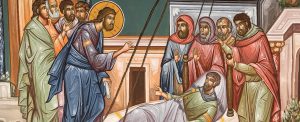
The Lord teaches the people from Peter’s boat for an hour or two, then tells him, “Put the nets back down and catch some fish.”
“Master, we worked hard all night and caught nothing! But at your word I will lower the nets.” Peter doesn’t expect any results; he is not acting in faith that he’ll receive a miracle. But he is acting in faithfulness. He’s already convinced that Jesus is the Christ, so he will obey this command even though it doesn’t make sense.
And when they did:
They caught such a large number of fish that their nets began to break. So they signaled their partners in the other boat to come and help them, and they came and filled both boats so full that they began to sink. When Simon Peter saw this, he fell at Jesus’ knees and said, “Go away from me, Lord; I am a sinful man!” For he and all his companions were astonished at the catch of fish they had taken.
Saint Peter sees for himself that Jesus is a wonderworker. As John the Baptist had predicted, Jesus is the Holy One, who will judge the world and baptize with fire and the Holy Spirit.
But Peter has exactly the wrong response. He sees the Holy One and says, “Oh no! The Holy One is right here in my boat — but I am an impure, unclean man, and not fit to be with him. Get away from me, Lord, I’m a sinner!”
And the Lord responds how?
“A sinner! Eww! I had no idea. Stop the boat! I’m getting off.”
No. He says “Don’t be afraid. Follow me, I’ll teach you how to fish for men.”
Today’s Gospel makes me think of the vision of the prophet Isaiah, 700 years earlier.
In the year that King Uzziah died, I saw the Lord, high and lifted up, seated on a throne; and the train of his robe filled the temple. Above him flew seraphim, each with six wings… calling to one another: Holy, holy, holy is the Lord of Hosts! The whole earth is full of his glory… “Woe to me!” I cried. “I am lost! For I am a man of unclean lips, and my eyes have seen the King, the Lord Almighty” (Isaiah 6:1-5).
But even as Isaiah is standing condemned, there is already an altar in the presence of God, where purification and acceptable sacrifice are always before the Lord. This is centuries before the coming of Christ – but in God’s dispensation, the Lamb of God was slain before the foundation of the world (Revelation 13:8).
Then one of the seraphim flew to me, having in his hand a live coal which he had taken from the altar. And he touched my mouth with it, and said: “Behold, this has touched your lips. Your iniquity is taken away and your sin is purified” (Isaiah 6:6-7).
The sacrifice that purifies sin is already prepared before you ever sinned.
“This is what love is: Not that we loved God, but that he loved us and sent his Son to be the reconciliation for our sins” (1 John 4:10). “For if, while we were God’s enemies, we were reconciled to him through the death of his Son, how much more, having been reconciled, shall we be saved through his life!” (Romans 5:10).
I think we are slow to repent partly because we feel like we haven’t suffered enough. It feels hypocritical and self-serving to immediately ask for forgiveness and promise repentance without being sorry enough to deserve it.
The Prodigal Son had a whole script ready to perform for his father: “Father, I have sinned against heaven and before thee…” But his father wasn’t having it. While the son was still a long way off, the father ran to meet him, put a ring on his finger, and had a welcoming feast. The father didn’t want drama and grief – he wanted his son back.
So come to repentance with your hands still dirty, your cruel words still in your ears, your steps still unsteady from drink.
What does a child do when she falls and skins her knee? She runs home, crying, “Mama!” to bring her wound to the one who can make it better. She is not ashamed – even if she got hurt doing something she shouldn’t, she runs urgently to the one who can fix it.
What do you do when you find symptoms in your body, or when the baby’s temperature is too high? You call a doctor. The emergency room isn’t going to scold you for having a lump, or a fever. You run to the one who can help.
But when we sin, we do the opposite. We confess that God is good, holy, and faithful to us, but we have betrayed him, we’ve been unfaithful to him, and shown that we don’t love or fear him. The Psalm asks, “Who can ascend the mountain of the Lord? The one who has clean hands and a pure heart” (Psalm 23:3-4 LXX) and that’s not us. So we feel condemned and frustrated and unworthy, so we shy away from prayer.
We’re like Adam in the garden, when the Lord comes walking in the cool of the day, calling for him: “Adam? Where are you?” And instead of running to the Lord to be made whole, Adam hides. He senses something is broken and wrong in him, so he covers himself with fig leaves to hide his shame.
“Get away from me, Lord, I am a sinful man!”
Once I visited a church, and had confession. It was during Matins, right in front of the iconostas, like in many churches, so the priest kept urging me to be quieter, to whisper so nobody would hear. It was his church, so of course I did what he said. But I kept thinking: If I was not ashamed to do and think and say these things right in front of the Lord and his Mother and all the saints – then why would I be ashamed to repent from them?
The Lord sees Peter, hears his confession, and gives him a commission: Become a fisher of men. When Peter denies the Lord three times, then later confesses his love for the Lord three times, the commission is renewed: Feed my sheep.
When Isaiah confesses his sins, it’s revealed that the Lord has already reconciled Isaiah to himself, and Isaiah receives a commission:
I heard the voice of the Lord saying, “Whom shall I send? And who will go for us?” And I said, “Here am I. Send me!” He said, “Go and speak to this people” (Isaiah 6:8-9).
* * *
I want to speak to anyone who is lying there today with Peter, fallen down in defeat, saying “Get away from me, I’m a sinner.” What passion is tripping you up daily? Is it envy? Gossip? Anger? Impurity? Overeating? There is something you need to know.
My friend learned Tae Kwon Do in the military. He was dismayed to find out that his first lessons were not how to kick or punch – but how to fall. Anyone can get knocked down, but a fighter needs to know how not to be injured when he falls, and how to quickly get back on his feet and be ready for another bout.
There is a Japanese proverb, 七転八起 Shichiten hakki. It means, roughly: Fall down seven times; get up eight.
Nobody ever went to hell because he fell into a sin. People fall away from the life of God when they stay down. A saint is not one who never fails or falls, but “he who perseveres to the end will be saved” (Matthew 24:13). “Blessed is the one who perseveres under trial because, having stood the test, he will receive the crown of life that the Lord has promised to those who love him” (James 1:12).
When Saul the persecutor was not yet Saint Paul, the Lord revealed himself; Saul fell off his horse and lay blinded by the side of the road. And the Lord told him: “Now get up and go into the city, and you will be told what you must do.” (Acts 9:6).
To Joshua, mourning after the Hebrews were defeated in battle, the Lord said, “Stand up! What are you doing down on your face? … Do not be discouraged. Take the whole army, and go up and attack the city.” (Joshua 7:10, 8:1)
Saint John Maximovitch writes: “God’s grace always assists those who struggle, but this does not mean that a struggler is always in the position of a victor. Sometimes in the arena the wild animals did not touch the righteous ones, but by no means were they all preserved untouched. What is important is not victory or the position of a victor, but rather the labor of striving towards God and devotion to Him… The Lord did not promise us positions as victors as a reward for righteousness, but told us, ‘In the world you will have tribulation — but be of good cheer, for I have overcome the world’” (John 16:33).
And Saint Joseph the Hesychast says: “Action is not to try out and then retreat, but to enter the battle, duel, defeat and be defeated, win and lose, fall and rise, crush the gates everywhere, and to expect struggles and fights until one’s last breath.”
If you’re not failing, you’re not trying. Fall down seven times; get up eight.
To the glory of God the Father, the Son, and the Holy Spirit.